ProConnect
Designed for collaboration, not just listings.
Context
Bayut ProConnect is a service marketplace experience designed to help users find and connect with the right service providers. Unlike a product marketplace, users are not comparing fixed items. They are comparing people, services, trust signals, relevance, and the confidence to reach out.
The challenge was to make provider discovery feel clear, credible, and actionable.
Description
I designed ProConnect as a service marketplace experience that helps users discover, compare, and connect with service providers more confidently. The work focused on service categories, provider discovery, search and filtering, provider cards, profile details, trust signals, and request flows.
The main UX challenge was reducing uncertainty. Users needed to know which provider matched their need, what services they offered, how credible they seemed, and what the next step was. I structured the experience around comparison, trust, and clear action so users were not just browsing a list — they were moving toward a confident connection.
The design organized provider information into clearer decision points: service relevance, details, availability, credibility, and request action.
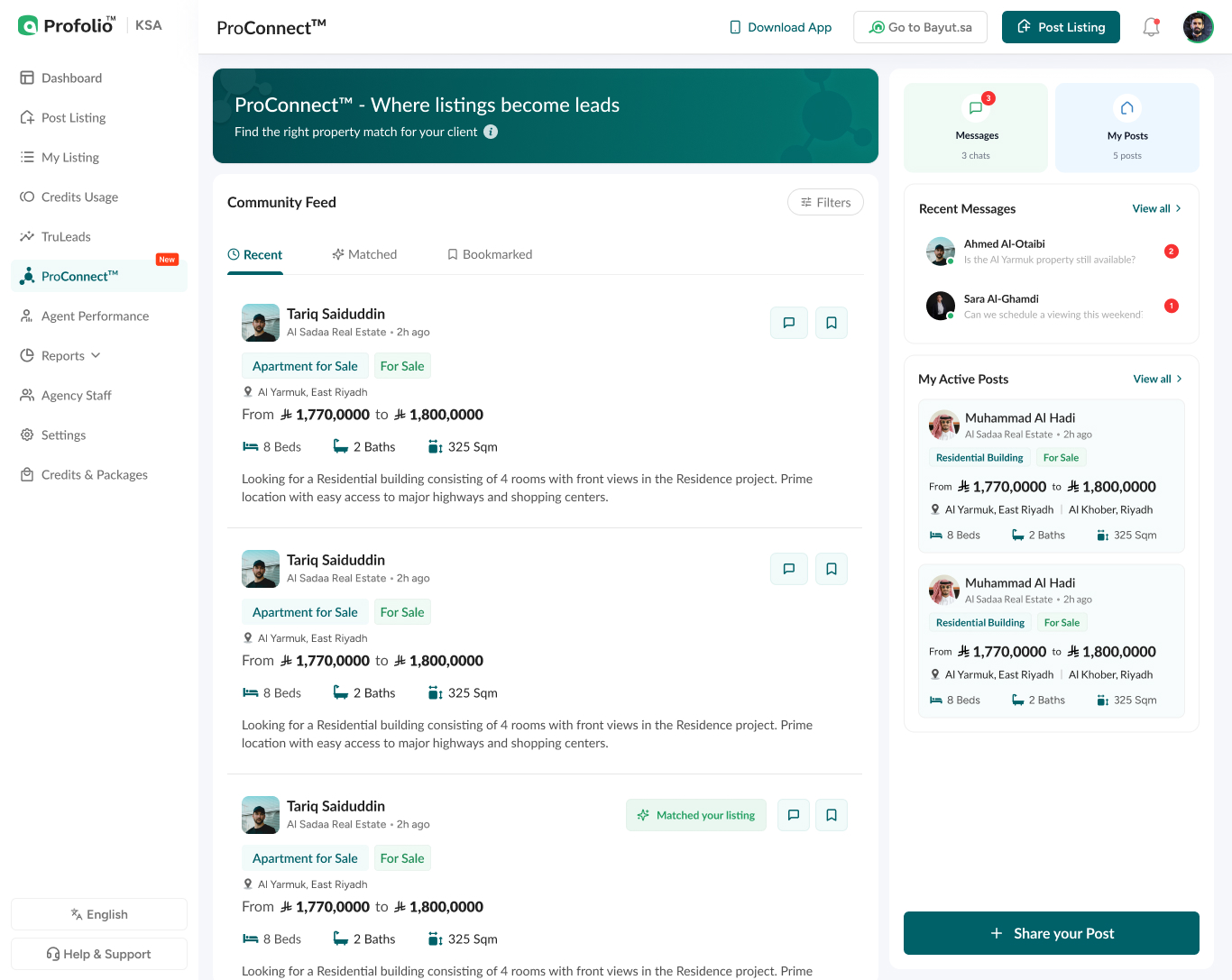
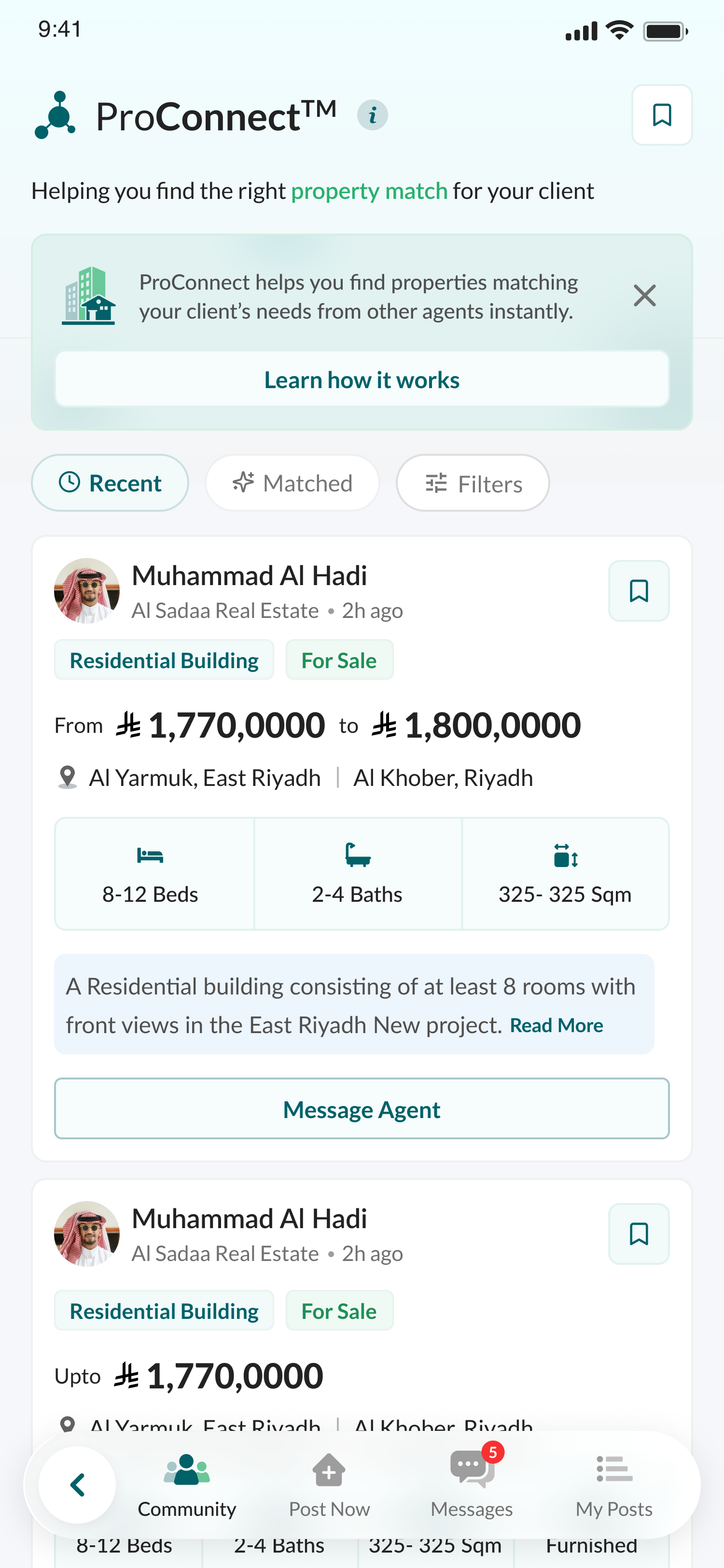
Great marketplaces don't just connect people to properties.
Bayut already helped agents publish listings to millions of buyers. But the moment two agents needed to work together — to find the right property for a waiting client — the platform stepped out of the room.
ProConnect is the part of Bayut where agents stop competing over listings and start trading opportunities. This case study is about designing that trust between people who have never met.
{{ card.title }}
{{ card.body }}
Read the full case study
The problem
Working together shouldn't mean leaving the platform.
Bayut already helped agents publish listings. But finding the right property for another agent's client still ran on WhatsApp groups, phone calls and personal favours.
The opportunities were already there. The connections weren't.
{{ c.title }}
{{ c.body }}
Research and user testing
I started by following the deal, not the brief.
I sat with how agents actually hand work to each other — where a request starts, everyone it touches, and the exact point it slips. Five lenses, and the gaps were hard to unsee.
How a good lead goes missing.
Eight steps, no system holding them together. Every handoff happens in a different place, and none of it is ever written down where it counts.
The biggest challenge was never inventory. It was coordination.
Everyone a single deal has to touch.
Every successful deal depends on more than two agents. Designing ProConnect meant understanding the entire collaboration ecosystem.
Pain points
Four gaps. Four places to build.
{{ o.area }}
{{ o.problem }}
{{ o.opportunity }}
Design direction
Open things up to understand. Close them down to decide. Twice.
{{ d.phase }}
{{ d.line }}
I didn't compare features. I compared how agents already collaborate.
Every one of these tools was great for talking. None of them was built to move a deal from one agent to the next.
Eight quick ideas. Three made the cut.
I gave myself eight minutes and eight ideas, then asked one honest question of each: would two agents who have never met actually use this to close a deal? Three of them held up.
The three winners weren't the cleverest sketches — they were the ones that survived that question. Feed, Match and Messaging became the spine of ProConnect; the rest became supporting cast.
The experience, screen by screen
Turning collaboration into product.
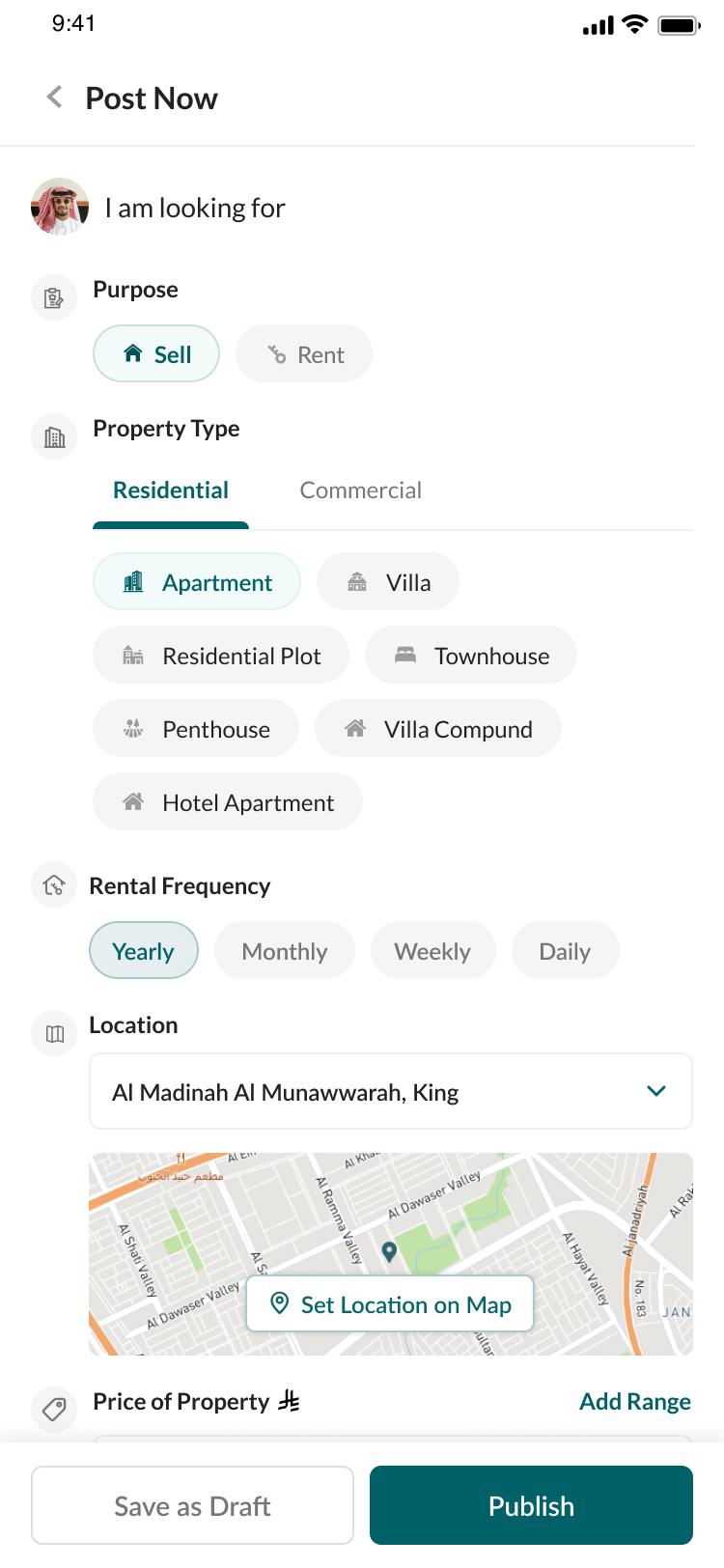
A request that used to vanish in a group chat — now a post the whole network can answer.
The same request, given structure: purpose, location, budget and beds — captured once, matched automatically, and answerable by anyone holding the right listing.
Designed for opportunities, not scrolling.
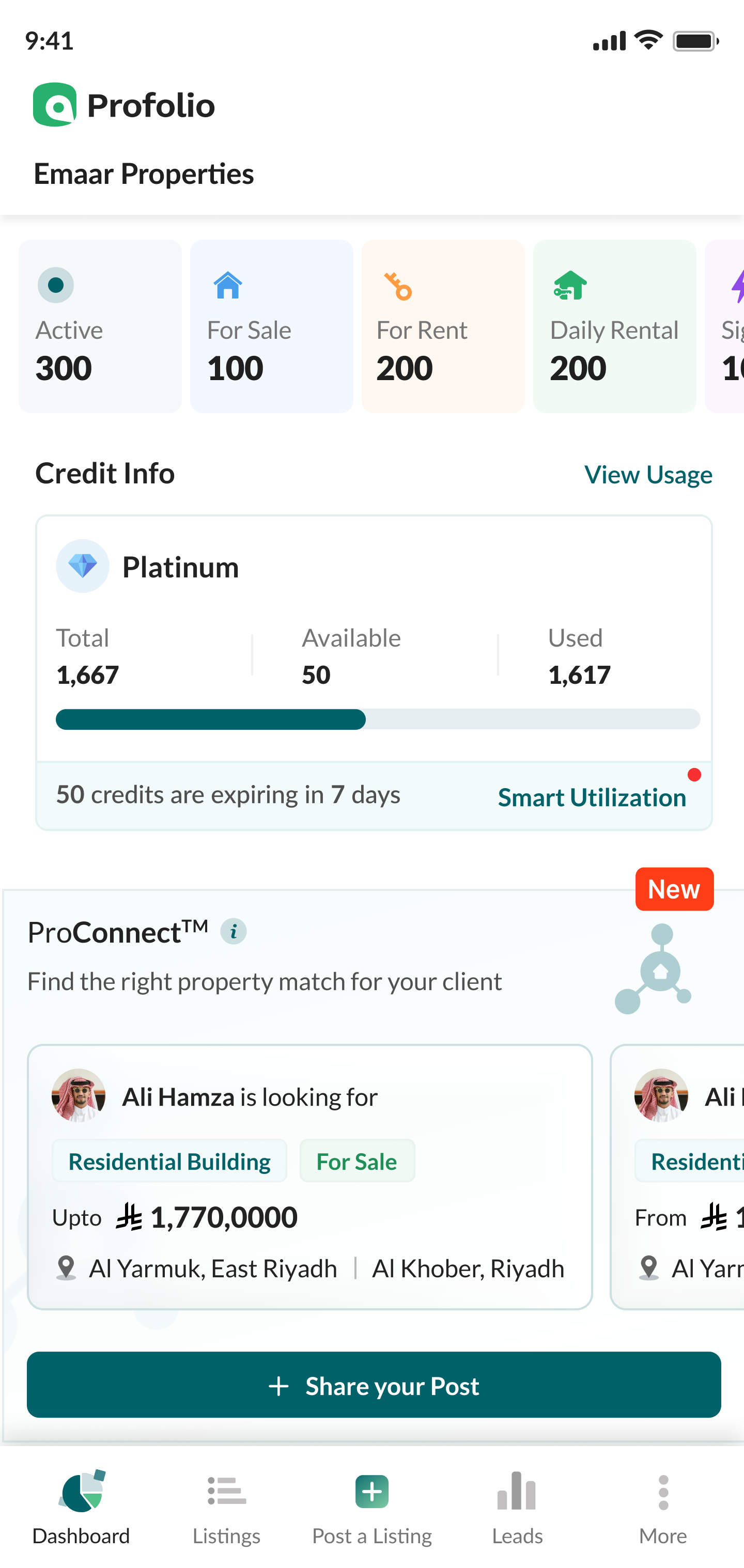
Tell the network exactly what your client needs.
Instead of a WhatsApp broadcast that disappears, agents post a structured requirement — purpose, type, location, budget — directly on ProConnect. Every detail stays in one place and the right agents find it automatically.
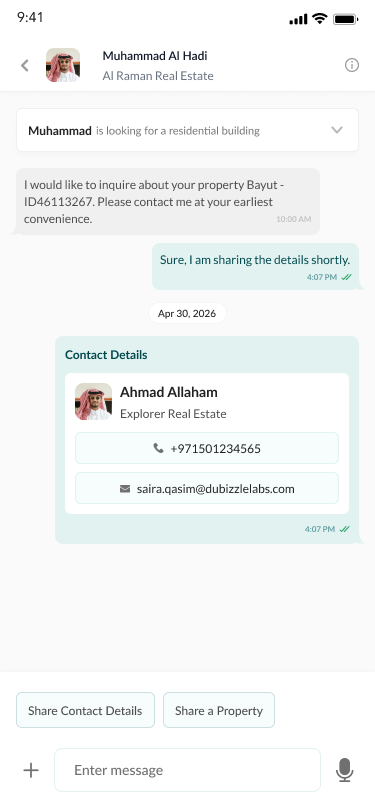
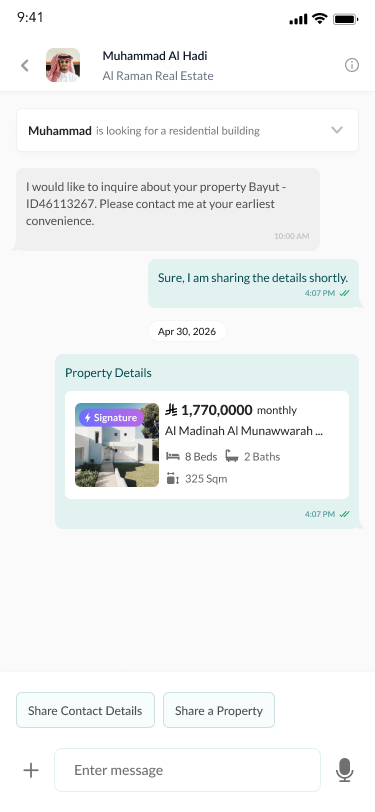
Conversations that move deals forward.
The chat isn't really the point — the deal is. Each thread keeps the property, the contact and the next step together, so the whole thing gets done without leaving Bayut.
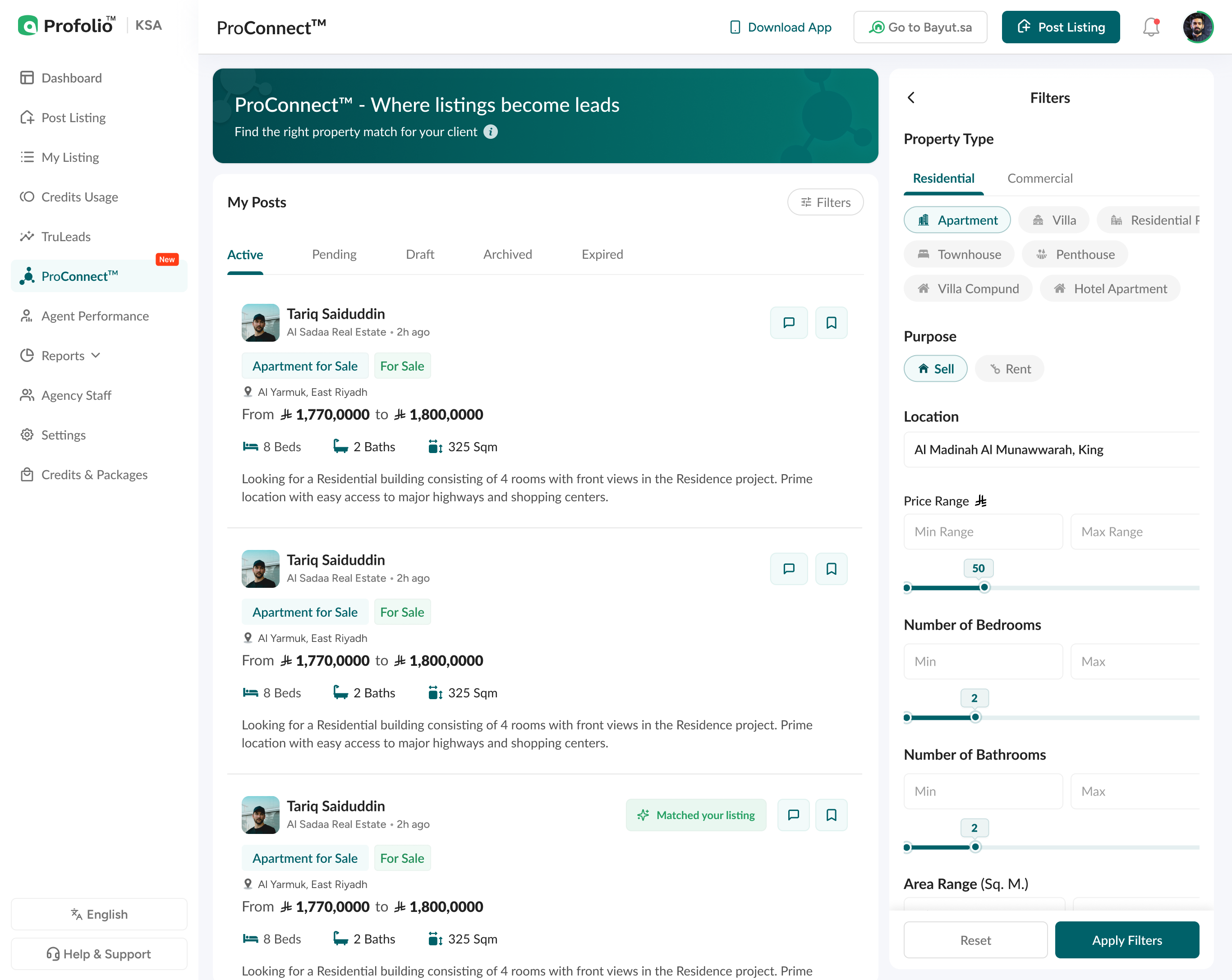
Filters that surface the right opportunities.
A feed full of irrelevant posts is just noise. The filter panel lets agents narrow by property type, purpose, location, price and bedrooms — so what remains is genuinely worth replying to.
Every conversation becomes a lead.
A collaboration only counts if the business can see it. The second contact details change hands, the deal flows into Bayut's existing lead stack — nothing retyped, no one's credit lost.
A nudge only when it's worth one.
Collaboration is time-sensitive. Notifications carry the moments that move a deal — a new match, a reply, a shared property — and stay silent the rest of the time.
Outcomes
Designed to create better connections.
{{ o.title }}
{{ o.body }}
Qualitative outcomes · pre-launch feature